




- En
- Fr
- عربي



SECURITY OF ARAB MARITIME CHOKEPOINTS: From Geopolitical Competition To Maritime Resilience
SECURITY OF ARAB MARITIME CHOKEPOINTS: From Geopolitical Competition To Maritime Resilience
Introduction
The strategic importance of Arab maritime waterways derives from geography. The Arab world connects the Mediterranean, the Red Sea, the Gulf of Aden, the Arabian Sea, and the Gulf through a chain of maritime corridors that link Europe, Asia and Africa. Several of the world's most consequential chokepoints are located in, or directly connected to, this strategic space. Their importance extends far beyond the states that border them, because a disruption in one corridor can increase sailing distances, shipping costs, insurance premiums, energy prices, food insecurity and geopolitical risk across distant regions.
The security of maritime corridors is inseparable from the security and economic development of the states that depend upon them. Maritime corridors have historically attracted external powers seeking commercial advantage, strategic access, military positioning or control over energy and trade routes. The record of Portuguese, Ottoman, Dutch, British, French, and later Israeli and Western involvement in this space shows that maritime geography repeatedly becomes an arena in which wider power relationships are contested.
The contemporary environment nonetheless requires a distinctive analytical approach. State competition remains central, but maritime threats increasingly arise from non-state armed groups, drones, missiles, mines, piracy, terrorism, cyber interference, disinformation, criminal networks and attacks against commercial vessels. At the same time, maritime infrastructure has become more technologically interconnected and therefore more vulnerable to cyber and information disruption.
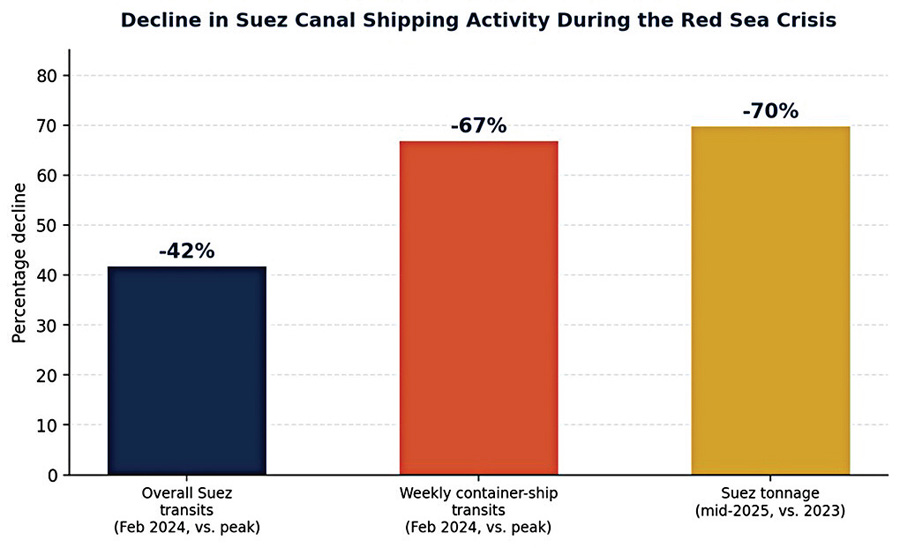
The Red Sea crisis since late 2023 illustrates this transformation. Attacks against commercial shipping forced many carriers to avoid the Red Sea and Suez Canal and to reroute around the Cape of Good Hope. The United Nations Trade and Development (UNCTAD) reported that Suez transits fell dramatically during 2024 and that rerouting increased voyage distances, shipping demand and costs.1 The World Bank likewise documented the global repercussions of the disruption for trade and development.2 By mid-2025, UNCTAD reported that tonnage through Suez remained around 70 percent below 2023 levels.3 In July 2026, the International Maritime Organization (IMO) again condemned renewed attacks on international shipping in the Red Sea, emphasizing risks to seafarers, the marine environment and global supply chains.4 The United Nations Security Council has separately and repeatedly demanded that Houthi forces cease all attacks against merchant and commercial vessels,5 while the UN Secretariat has condemned specific incidents as they occurred.6
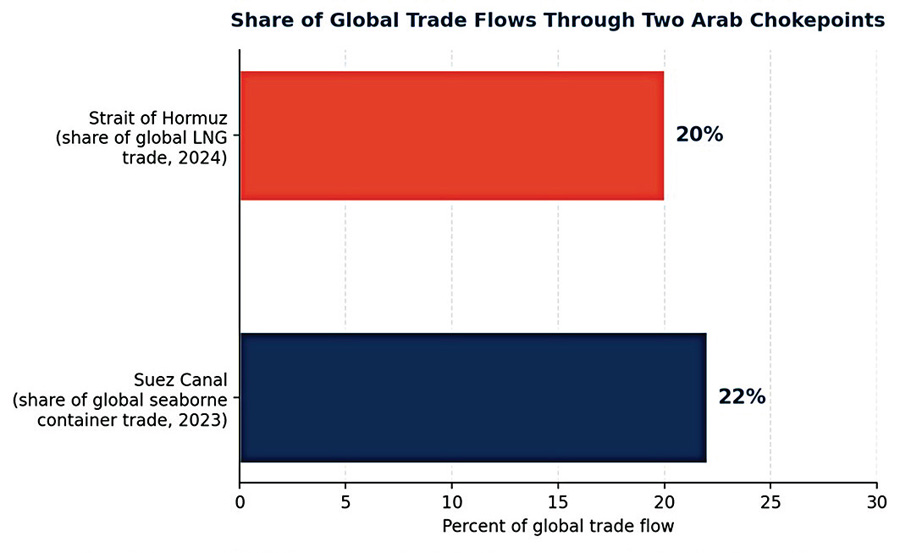
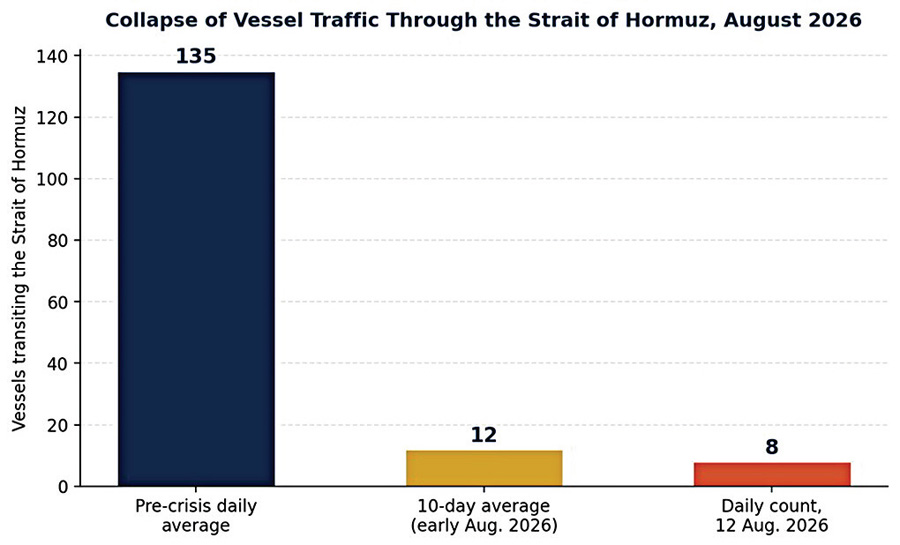
The Strait of Hormuz demonstrates the energy dimension even more starkly. The waterway remains a critical route for oil and liquefied natural gas exports from the Gulf. In 2024, about one-fifth of global LNG trade transited Hormuz.7 The 2026 crisis has shown how quickly a military confrontation can affect commercial traffic and energy markets. Reuters reported on 12 August 2026 that only a small number of vessels were being tracked through the Strait compared with normal traffic levels, illustrating the extraordinary sensitivity of global shipping to geopolitical escalation.8
These developments suggest that maritime security should no longer be understood principally as the physical protection of a waterway by naval forces. It should instead be understood as the capacity of a maritime system to remain safe, accessible, economically functional and legally governed during periods of stress.
This study therefore pursues four objectives. First, it assesses the strategic geography of the major Arab maritime corridors. Second, it examines the legal framework governing navigation through them. Third, it analyzes the contemporary threat environment, including state competition, non-state violence, piracy, missiles and drones, cyber threats and economic disruption. Fourth, it proposes a practical framework for Arab maritime security based on resilience, cooperation, maritime domain awareness and diversified routes and energy infrastructure.
The analysis follows a qualitative strategic-analysis approach that combines historical analysis, geopolitical assessment, international maritime law and contemporary security analysis. It is organized around three complementary concepts: chokepoint theory, maritime security and resilience. Chokepoint theory emphasizes the disproportionate strategic importance of geographically narrow passages through which large volumes of trade or energy must move. Maritime-security analysis adds the actors and threats that operate around those passages, including states, navies, coast guards, commercial shipping, armed groups, criminal networks and international organizations. Resilience extends the analysis by asking how a maritime system can maintain essential functions when deterrence or prevention fails.
Each corridor is accordingly evaluated through five questions: What is its geographic and economic significance? What legal regime governs navigation? What are the principal contemporary threats? How can disruption propagate through regional and global systems? What combination of national, regional and international measures can improve resilience?
This approach also carries an important methodological caution. A contemporary academic treatment must preserve the legitimate concern with Arab sovereignty and collective security while avoiding unsupported assumptions about the intentions of particular states. Current maritime security is best understood through observable capabilities, behavior, legal obligations, institutional arrangements and strategic incentives.
Part One
Conceptual Foundations and Strategic Geography
1. Conceptualizing Maritime Security
Security is broader than military power. Classical strategic thought linked security with power, stability, protection of interests and development, and that insight remains foundational even as the concept is reformulated for a contemporary setting.
Maritime security may be defined as the condition in which maritime spaces, vessels, people, infrastructure, resources and maritime commerce are protected against coercion, armed attack, criminal activity, accidents, environmental hazards and disruptive interference, while navigation remains governed by applicable international law.
This definition contains five interconnected dimensions.
First is military security: deterrence of aggression, protection of territorial waters and maritime infrastructure, surveillance, coastal defence and the ability to respond to armed attacks.
Second is navigational security: preservation of safe and predictable commercial navigation and protection of seafarers. The freedom of navigation principle is not simply an abstract legal concept; it is an economic necessity for states whose food, energy and industrial supply chains depend upon maritime transport.
Third is economic security: continuity of trade, energy flows, port operations, canal revenues and supply chains. A maritime corridor can remain physically open while becoming economically unusable, because insurance costs, war-risk premiums or delays make transit commercially unattractive.
Fourth is environmental security: A missile attack on a tanker, collision in a congested chokepoint, grounding, or damage to offshore infrastructure can create consequences extending far beyond the immediate military theatre. The IMO's recent statements on Red Sea attacks explicitly connect maritime security with marine environmental risks.9
Fifth is technological and informational security: Modern maritime systems depend upon automatic identification systems, satellite communications, electronic navigation, port information systems, logistics platforms and digital infrastructure. Cyber disruption can therefore produce effects similar to physical blockade without a single ship being attacked.
Resilience adds a sixth dimension: the capacity to anticipate disruption, absorb its effects, maintain essential functions, adapt operations and recover rapidly. A resilient maritime strategy does not assume that every threat can be prevented; instead, it seeks to reduce the consequences when prevention fails.
This distinction is important for Arab maritime policy. Traditional security thinking often asks: “Who controls the chokepoint?” A resilience-based approach asks instead: “How can the maritime system continue to function if the chokepoint is threatened or temporarily disrupted?” The second question is strategically more useful, because no single state can guarantee permanent control over an international maritime system.
2. Strategic Geography of the Arab Maritime Corridors
2.1 The Red Sea
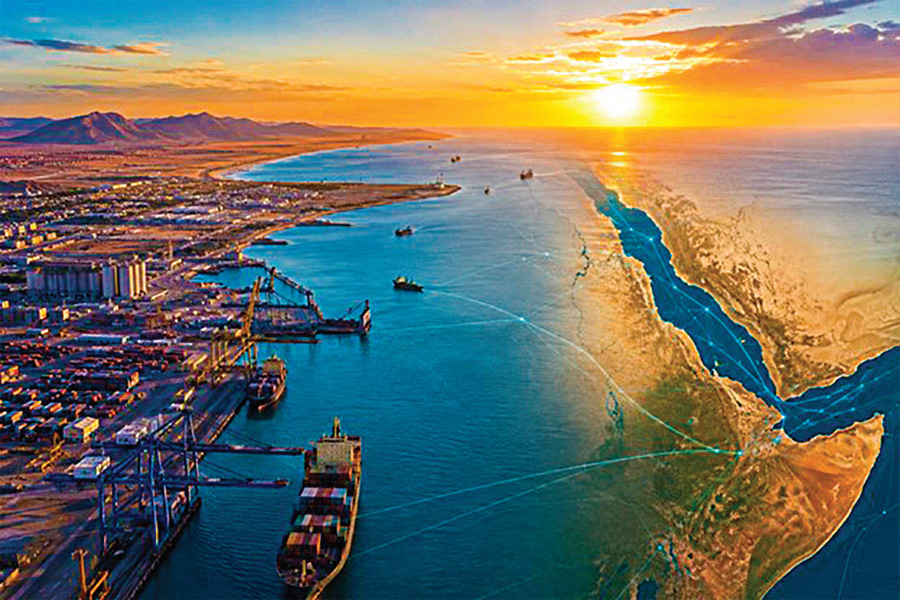
The Red Sea is a semi-enclosed maritime corridor linking the Mediterranean system through Suez with the Indian Ocean through Bab el-Mandeb. Its strategic significance derives from its position between Africa and Asia and from the fact that the Suez Canal transforms the Red Sea into the shortest maritime connection between major Asian and European markets.
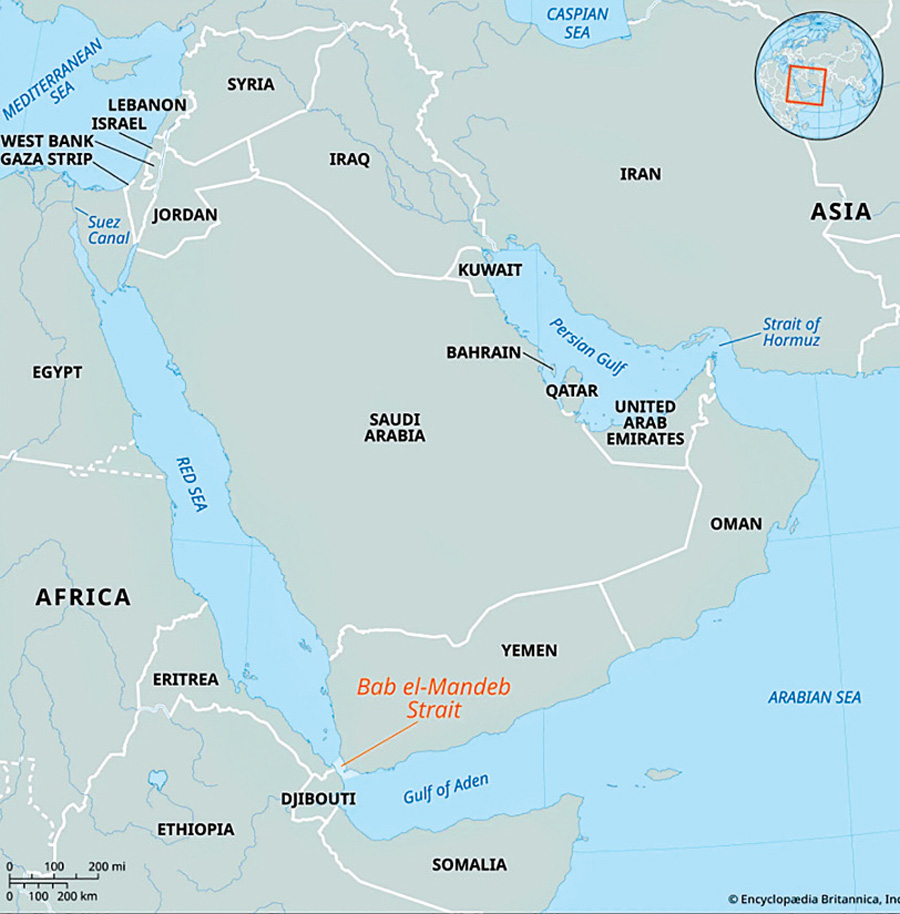
The Red Sea should not be treated as an exclusively Arab space. Its littoral includes Egypt, Sudan, Eritrea, Djibouti, Yemen, Saudi Arabia, Jordan and Israel. This geographic reality requires a distinction between Arab strategic interests and the legal rights and security interests of all littoral states.
The region's security is also inseparable from the Horn of Africa. Instability in Somalia, piracy, the weakness of coastal governance, conflict in Yemen, competition over ports and foreign military facilities all affect the southern entrance to the Red Sea. The strategic lesson is that the security of the Red Sea cannot be separated from the security of the Gulf of Aden and the Horn of Africa.
Events since 2023 have confirmed this interdependence. Attacks on commercial vessels in and around the Red Sea have demonstrated that a relatively small number of armed actors can generate global economic effects when operating near a chokepoint.10 The result is a form of asymmetric strategic leverage: an actor does not need to control the entire sea to make the route commercially unattractive.
Figure 2. The Red Sea
2.2 The Suez Canal
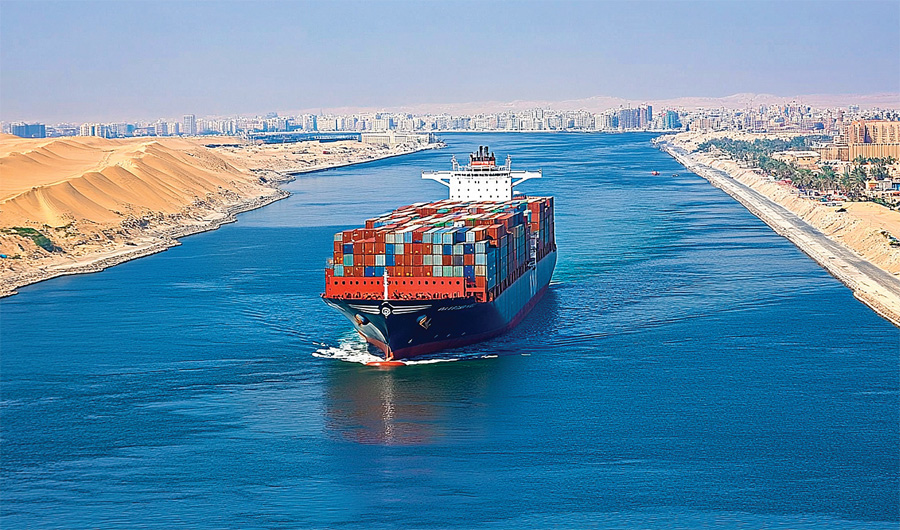
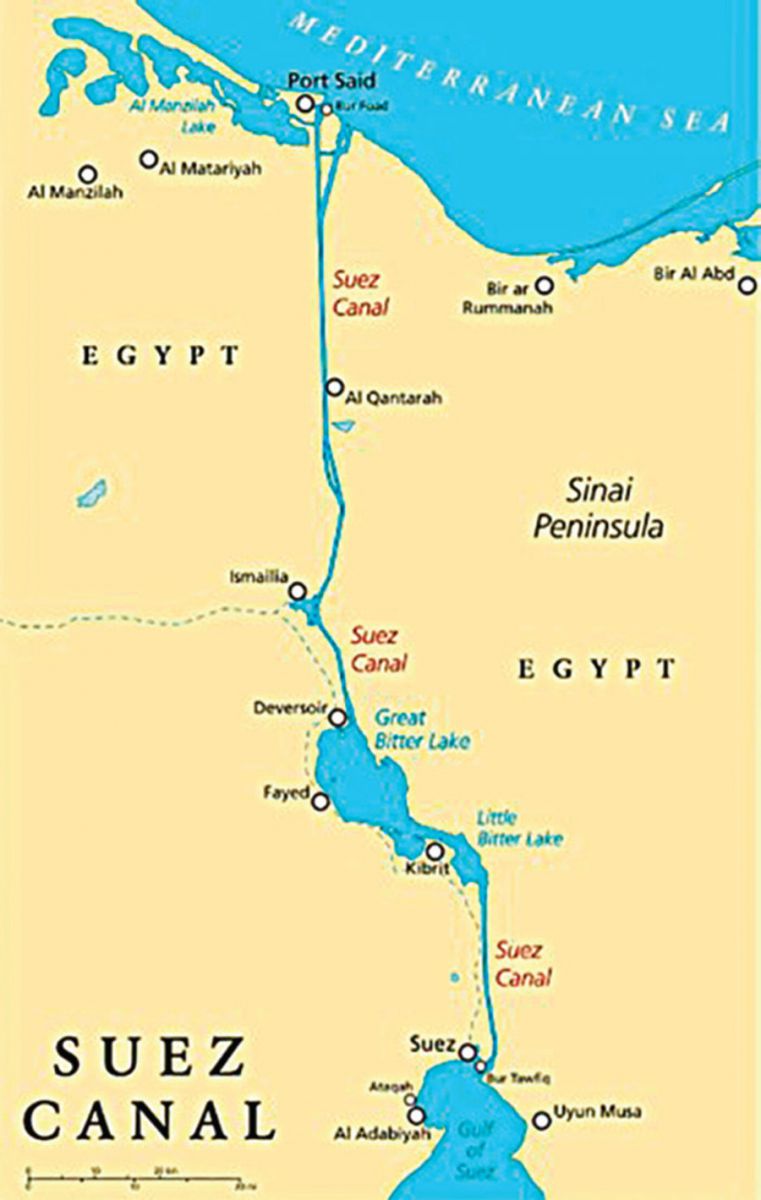
The Suez Canal remains one of the world's most important artificial maritime chokepoints. Its strategic value is based on the enormous distance and time saved by connecting the Mediterranean and the Red Sea without requiring vessels to sail around southern Africa. UNCTAD reported that approximately 22 percent of global seaborne container trade passed through the canal in 2023.11
The experience since late 2023 demonstrates that the canal's strategic importance is also a source of vulnerability. When security conditions in the Red Sea deteriorated, carriers were able to avoid the canal by sailing around the Cape of Good Hope. This did not eliminate trade, but it imposed longer voyages, increased fuel consumption, required more vessels to maintain schedules, increased emissions and created pressure on freight rates and port capacity.12
The Suez Canal therefore represents a classic example of chokepoint interdependence. Egypt derives substantial economic benefits from the canal, while the international system depends upon its reliability. This creates a shared interest in security, but it does not eliminate Egyptian sovereignty. The strategic objective should be to protect the canal as an international commercial artery while respecting the legal and sovereign framework governing it.
Figure 3. The Suez Canal
2.3 Bab el-Mandeb
Bab el-Mandeb is the southern gateway to the Red Sea and therefore the operational link between the Suez Canal and the Indian Ocean. Its importance is amplified by its relationship with the Gulf of Aden and the Horn of Africa.
Contemporary analysis should place less emphasis on static possession of individual islands and approaches surrounding the strait, and more on surveillance, access, maritime domain awareness and the ability to protect shipping corridors.
The principal contemporary threats include missile and drone attacks, piracy and armed robbery, trafficking, civil conflict in Yemen, instability in Somalia, and competition among regional and extra-regional powers. The IMO recorded multiple piracy and armed-robbery incidents in the Red Sea and Gulf of Aden in 2026 and has continued to warn about attacks on commercial shipping, including its call for the release of seafarers held captive following piracy incidents.13
Bab el-Mandeb demonstrates why maritime security cannot be achieved through naval presence alone. Effective security requires intelligence sharing, coastal surveillance, port security, search and rescue, counter-piracy capabilities, diplomatic engagement and efforts to reduce the conflicts that generate attacks in the first place.
2.4 The Gulf of Aqaba and the Straits of Tiran
The Gulf of Aqaba is a strategically sensitive semi-enclosed body of water bordering Egypt, Israel, Jordan and Saudi Arabia. The legal and political status of navigation through its entrance has historically been contested and became a central issue in Arab-Israeli conflicts.
The issue is best understood through a combination of territorial sovereignty, navigation rights, treaty obligations and the applicable rules of international law, rather than as a simple unilateral question of “free” versus “innocent” passage.14 The legal regime of the Gulf and the Straits of Tiran has been shaped by subsequent political and treaty arrangements, including the Egypt-Israel peace framework and later regional developments.
The strategic importance of the Gulf has also changed because of the development of tourism, ports, energy infrastructure and cross-border economic projects. Its security consequently affects not only military strategy but also regional economic connectivity.
2.5 The Gulf and the Strait of Hormuz
The Gulf is a strategically important maritime energy system connected to the Indian Ocean through the Strait of Hormuz. Its geography creates a structural vulnerability: major energy exporters depend upon a narrow maritime exit, while major Asian and global economies depend upon uninterrupted energy flows.
The importance of Hormuz is often expressed through the volume of oil that passes through it, yet contemporary analysis must also emphasize LNG. According to the U.S. Energy Information Administration, about 20 percent of global LNG trade transited Hormuz in 2024, primarily from Qatar and the United Arab Emirates.15 Asian markets, especially China, India and South Korea, are major destinations.16
Hormuz therefore links Arab maritime security directly to Asian energy security. The strategic geography is multipolar: Gulf exporters, Asian importers, the United States, European states, China, India and other actors all have strong interests in the waterway.
The 2026 crisis demonstrates the consequences of this interdependence. The sharp reduction in commercial traffic through Hormuz illustrates how rapidly geopolitical conflict can become a global economic problem.17 The strategic lesson is clear: deterrence and naval protection remain important, but redundancy, alternative export routes, strategic reserves and diversified energy systems are equally important.
Figure 4. Data: UNCTAD (2024a, a cited in this study): Energy Information administration (2025).
3. International Law and Arab Maritime Chokepoints
International law sits at the center of any serious analysis of these corridors. The principal legal framework is the 1982 United Nations Convention on the Law of the Sea, or UNCLOS.18 UNCLOS distinguishes among internal waters, territorial seas, exclusive economic zones, high seas and straits used for international navigation. It also distinguishes innocent passage from transit passage.
For straits used for international navigation connecting one part of the high seas or an exclusive economic zone with another, the regime of transit passage is particularly important. Transit passage provides ships and aircraft with rights necessary for continuous and expeditious transit, subject to the obligations established by the Convention.19
This regime differs from innocent passage. Innocent passage concerns passage through the territorial sea and is subject to the condition that the passage is not prejudicial to the peace, good order or security of the coastal state. Transit passage is broader and is designed to preserve international navigation through strategically important straits.
This distinction matters greatly for Hormuz and Bab el-Mandeb. Attempts to characterize these straits simply as waterways over which coastal states possess unrestricted control are inconsistent with the modern law of the sea. At the same time, the law does not eliminate coastal-state security interests. Coastal states retain jurisdiction and rights under UNCLOS, and ships exercising passage rights have corresponding duties.
The legal status of the Suez Canal is distinct from that of a natural strait. The canal is an artificial waterway located in Egyptian territory and is governed by a specific international treaty framework, most notably the 1888 Convention Respecting the Free Navigation of the Suez Maritime Canal,20 alongside Egyptian law and subsequent practice. The canal should therefore not be analyzed simply by applying the rules applicable to natural international straits.
The broader legal principle is that maritime security requires balancing freedom of navigation with coastal-state sovereignty and security. Neither absolute freedom nor absolute coastal control provides an adequate framework.
4. Historical Patterns of External Competition
A recurring pattern runs through the history of these waterways: external powers have repeatedly sought access to Arab maritime corridors when those corridors offered commercial or strategic advantages.
Portuguese expansion into the Indian Ocean and Red Sea in the sixteenth century represented an early attempt to use naval power to redirect trade and weaken established commercial networks. Ottoman intervention followed in part as a response to Portuguese penetration. Dutch and British competition later transformed the maritime balance, while French and Italian involvement added additional layers of imperial competition.
British strategy became especially significant after the opening of the Suez Canal, because maritime access to India and later to Gulf energy resources became central to imperial strategy. Aden, Socotra, the Red Sea and Gulf ports were therefore integrated into a broader network of strategic positions.
This historical pattern should not be interpreted as evidence that contemporary foreign naval presence is necessarily equivalent to colonial occupation. The international system is fundamentally different, and many foreign naval deployments are based on treaties, host-state consent, coalition mandates or responses to specific threats. Nevertheless, the underlying warning remains analytically useful: dependence on external military protection can create political and strategic vulnerabilities for coastal states.
The contemporary form of external competition is more pluralistic. The United States remains a major naval power in the region; European states conduct maritime security operations; China has established a military support facility in Djibouti; Russia has sought influence and maritime access in the Red Sea; and regional powers are developing their own naval and missile capabilities. The maritime environment is therefore characterized not by a single hegemon but by overlapping strategic presences.
This creates a dilemma. External naval powers can contribute significantly to maritime security, but their presence can also become part of regional rivalry. The challenge is therefore not to eliminate international involvement, but to establish rules and cooperative mechanisms that prevent maritime security from becoming an instrument of strategic domination.
Part Two
Contemporary Threats and a Resilience Framework
1. The Contemporary Threat Environment
1.1 Interstate conflict
State-to-state rivalry remains a major source of maritime insecurity. The Gulf demonstrates how territorial disputes, military competition and rival alliances can transform a narrow waterway into a strategic pressure point. The Red Sea similarly reflects the interaction of regional conflicts with international power competition.
1.2 Non-state armed groups
One of the most significant shifts in the threat environment is the ability of non-state actors to threaten international maritime trade with relatively inexpensive systems. Missiles, one-way attack drones, unmanned surface vessels and commercial satellite communications have reduced the technological barrier to maritime disruption. The Red Sea crisis demonstrates this asymmetric dynamic: a non-state actor operating from a geographically constrained area has been able to impose significant costs on global shipping without possessing a conventional blue-water navy.21
1.3 Piracy and organized crime
Piracy in the Gulf of Aden remains a reminder that maritime security depends on coastal governance. Even where piracy declines because of naval patrols, the underlying political and economic conditions may remain unresolved.22 Trafficking, smuggling, illegal fishing and other forms of maritime crime also exploit weak maritime governance.
1.4 Mines and underwater threats
Mines remain among the most cost-effective means of threatening chokepoints. Their presence can force a major reduction in traffic even before they are confirmed, because commercial operators respond to uncertainty and insurance requirements. Underwater infrastructure, including pipelines and communications cables, adds a further layer of vulnerability.
1.5 Cyber and electronic threats
Ports, canals, shipping companies and naval forces are increasingly digital. Cyberattacks can interfere with cargo management, navigation support, vessel tracking and port operations. The security of maritime chokepoints must therefore include cyber resilience.
1.6 Environmental and climate risks
Climate change adds a non-military dimension to maritime security. Extreme weather, coastal flooding, sea-level rise, heat stress and ecosystem degradation can affect ports and coastal infrastructure. The Panama Canal drought demonstrated that a waterway can be disrupted without conflict. Arab maritime planning should therefore integrate climate adaptation into security planning.
1.7 Information and economic warfare
Maritime insecurity is also amplified by information. False reports about attacks, manipulated ship-tracking data, misinformation concerning safe corridors and uncertainty about insurance or sanctions can influence commercial decisions. The economic consequences of maritime disruption can therefore occur even when physical damage is limited.
2. From Maritime Security to Maritime Resilience
The central analytical proposition of this study is that maritime security must be reconceptualized as resilience. A resilient Arab maritime system should have six capabilities.
First, maritime domain awareness. Littoral states should be able to maintain a common operational picture using coastal radars, AIS, satellite data, electro-optical systems, unmanned systems and intelligence-sharing mechanisms. Information should be fused regionally rather than maintained exclusively at the national level.
Second, layered protection. Security should be organized in layers: port security, coastal surveillance, offshore infrastructure protection, escort and convoy capabilities when required, rapid response forces, search and rescue and medical evacuation.
Third, redundancy. States should develop alternative ports, pipelines, storage facilities and export routes. Redundancy does not replace chokepoint security; it reduces the strategic leverage that an adversary gains by threatening one chokepoint.
Fourth, institutional cooperation. Maritime security should involve navies, coast guards, port authorities, customs agencies, energy ministries, shipping companies and international organizations. A purely military response cannot manage all dimensions of maritime risk.
Fifth, legal preparedness. States should clarify rules of engagement, jurisdiction, boarding authority, evidence collection, search and rescue responsibilities and procedures for cooperation during incidents.
Sixth, recovery capacity. Maritime security planning should include contingency plans for rerouting ships, protecting supply chains, managing fuel stocks, reallocating port capacity and communicating transparently with commercial operators.
3. Strategic Assessment: The Red Sea after 2023
The Red Sea crisis offers the most important contemporary test of the argument advanced here, and its documented effects on canal traffic23 yield five lessons.
The first lesson is that geography still matters. Despite technological advances and globalized supply chains, the concentration of trade around a few chokepoints creates systemic vulnerability.
The second lesson is that asymmetric threats can generate disproportionate economic effects. The attacking actor does not need to sink large numbers of ships; the mere perception of unacceptable risk can cause commercial operators to reroute.
The third lesson is that naval power alone cannot restore long-term stability. International naval missions can protect ships, but the political conflict generating the attacks must also be addressed.
The fourth lesson is that maritime security has become a global public-good problem. A disruption in the Red Sea affects Asian manufacturers, European consumers, African importers, Gulf exporters and international energy markets simultaneously.
The fifth lesson is that regional states must play a larger role. International naval coalitions may be necessary in crises, but sustainable security requires stronger regional maritime institutions, coastal surveillance and political mechanisms.
Figure 5. Decline in Suez Canal shipping activity during the Red Sea crisis. Data: UNCTAD.24
4. Strategic Assessment: The Strait of Hormuz
Hormuz represents a different but complementary vulnerability. Whereas the Red Sea crisis has centered heavily on attacks against commercial shipping, Hormuz demonstrates the consequences of state-level military confrontation involving a major energy chokepoint. The 2026 disruption reinforces four conclusions.
First, energy dependence remains a strategic vulnerability despite the growth of renewable energy. Oil and LNG remain essential to global industry, transport and electricity generation.
Second, Asian energy dependence has become central. An analytical model that understands Gulf security primarily through Western oil dependence is incomplete; China, India, Japan, South Korea and other Asian economies have major interests in uninterrupted Gulf energy flows.25
Third, alternative infrastructure matters. Pipelines that bypass Hormuz, strategic petroleum reserves, diversified LNG supply and alternative suppliers can reduce—but cannot eliminate—the strategic importance of the Strait.
Fourth, maritime security cannot be separated from diplomatic crisis management. The safest commercial corridor is one in which political actors have incentives not to escalate; the collapse of vessel traffic through Hormuz in August 2026 illustrates how directly commercial shipping responds to the state of diplomacy.26
Figure 6. Collapse of vessel traffic through the Strait of Hormuz, August 2026. Data: Reuters.27
5. Toward an Arab Maritime Security Framework
Greater Arab maritime cooperation requires institutional modernization. A contemporary Arab Maritime Security Framework should be built around five pillars.
Pillar One: Regional Maritime Domain Awareness
Arab coastal states should establish interoperable maritime surveillance and information-sharing systems. The objective should be a common maritime picture covering the Red Sea, Gulf of Aden and Gulf approaches. Such a system could integrate national sensors with satellite information and commercial shipping data.
Pillar Two: Coordinated Maritime Response
The region requires mechanisms for coordinated response to attacks, piracy, pollution, search and rescue and major accidents. This does not necessarily require a single Arab navy; a networked model may be more politically realistic and operationally effective.
Pillar Three: Protection of Critical Maritime Infrastructure
Ports, canals, offshore energy installations, pipelines, undersea cables and navigation systems should be treated as critical infrastructure. Security assessments should identify dependencies and prioritize redundancy.
Pillar Four: Legal and Diplomatic Coordination
Arab states should develop a common legal position on navigation rights, maritime boundaries, rules governing foreign naval deployments and protection of commercial shipping. Differences among states will remain, but clearer common principles can reduce miscalculation.
Pillar Five: Maritime Economic Resilience
Security policy should be connected to economic planning. Governments and private shipping companies should conduct joint stress tests for prolonged closure of Suez, Bab el-Mandeb or Hormuz. These exercises should examine fuel supplies, food imports, port congestion, insurance, inflation and alternative routes.
6. Policy Recommendations
1.Coordination & confidence-building — regional mechanism, MDA systems, hotlines, joint exercises.
2. Operational capacity — coast guard/policing, contingency plans, search & rescue, pollution response.
3. Economic & infrastructure resilience — alternative routes, storage, critical infrastructure, climate adaptation.
4. Cyber security & diplomacy — cyber standards, de-escalation mechanisms, legal frameworks for naval cooperation.
5. Yemen/Somalia & institution-building — treating them as central, plus the research and training center.7
Conclusion
Arab maritime corridors are strategic assets whose security is inseparable from regional security and economic development. What continues to evolve is the nature of the threats and the structure of the international system in which these corridors sit.
The maritime security problem is no longer adequately described as a contest between Arab states and foreign fleets. It is a multidimensional system involving states, non-state armed groups, commercial shipping, international organizations, energy markets, technology and environmental risks. The distinction between military security and economic security has become increasingly difficult to sustain.
History demonstrates that maritime chokepoints have repeatedly attracted external powers because geography creates strategic value. Contemporary international naval presence should not automatically be equated with colonial control, but neither should dependence on external protection be treated as a substitute for regional capability. The strategic objective should be cooperation without strategic dependency.
The Red Sea crisis since 2023 has provided a powerful demonstration of the systemic consequences of maritime insecurity. Attacks on individual commercial vessels caused carriers to avoid an entire maritime corridor, producing longer voyages, higher costs, greater emissions and supply-chain disruptions far from the original conflict zone.28 The IMO's continuing warnings in 2026 demonstrate that the security challenge remains active.29
The Strait of Hormuz provides an even stronger illustration of the connection between maritime and energy security. Its importance is not limited to oil; LNG flows through the Strait are also critical to global energy markets, particularly in Asia.30 The 2026 disruption shows that geopolitical escalation at a single chokepoint can produce consequences for energy supply, inflation, shipping and international stability.31
These developments reinforce a fundamental strategic principle: the objective should not be absolute control of maritime chokepoints, but reliable access, lawful navigation, deterrence of attack, resilience against disruption and rapid recovery.
For Arab states, this requires moving from fragmented national maritime policies toward coordinated regional capabilities. Such cooperation should not be understood as a political slogan; it can begin with practical measures: shared maritime surveillance, information exchange, coordinated search and rescue, common contingency planning, protection of critical infrastructure, maritime cyber security and diplomatic mechanisms for crisis management.
The most sustainable maritime order will also require engagement with neighboring and extra-regional states. The Red Sea cannot be secured without considering the Horn of Africa; Hormuz cannot be stabilized without considering Iran and Oman; Suez cannot be protected without addressing the security environment of the wider Red Sea. Maritime geography imposes cooperation even where politics resists it.
The concept of “Arab maritime security” should therefore evolve from a primarily territorial and military conception toward a regional resilience framework grounded in international law.32 Such a framework would protect sovereignty while recognizing that maritime commerce is inherently international. It would preserve freedom of navigation while protecting coastal-state security. It would accept international cooperation while avoiding permanent strategic dependency. And it would combine military deterrence with diplomacy, economic diversification, technology and institutional capacity.
The ultimate measure of maritime security is not the number of warships in a waterway. It is whether ships can navigate safely, ports can function, energy and food can move, coastal communities remain secure, the marine environment is protected, and crises can be contained before they become regional or global disruptions.
In this sense, the security of Arab maritime corridors is not only a regional strategic problem. It is a test of the resilience of the international maritime order itself.
References
1. Convention Respecting the Free Navigation of the Suez Maritime Canal, Oct. 29, 1888, 3 Am. J. Int'l L. Supp. 123 (1909).
2. International Maritime Organization. (2026a, July 6). IMO Secretary-General calls for urgent release of 44 seafarers held by pirates [Press briefing]. https://www.imo.org
3. International Maritime Organization. (2026b). Red Sea area: Conflict-related attacks on shipping [Data update]. https://www.imo.org
4. International Maritime Organization. (2026c, July 23). Statement on recent attacks on ships in the Red Sea [Press briefing]. https://www.imo.org/en/mediacentre/ pressbriefings/pages/statement-on-recent-attacks-in-the-red-sea.aspx
5. Reuters. (2026, August 12). Hormuz shipping traffic falls to one-week low amid hostilities. https://www.arabnews.com/node/2654331/middle-east
6. United Nations. (1982). United Nations Convention on the Law of the Sea. https://www.un.org/depts/los/convention_agreements/texts/unclos/unclos_e.pdf
7. United Nations. (2025a, March 17). Note to correspondents: On the recent developments in Yemen [Press release]. https://www.un.org
8. United Nations. (2025b, July 11). Statement attributable to the Spokesman for the Secretary-General – on attacks in the Red Sea [Press release]. https://news.un.org/en/story/2025/07/1165378
9. United Nations Security Council. (2025). Resolution 2768 (2025) [S/RES/2768]. https://digitallibrary.un.org/record/4072358
10. United Nations Trade and Development. (2024a, February 22). Navigating troubled waters: Impact to global trade of disruption of shipping routes in the Red Sea, Black Sea and Panama Canal (UNCTAD/OSG/INF/2024/2). https://unctad.org/publication/ navigating-troubled-waters-impact-global-trade-disruption-shipping-routes-red-sea-black
11. United Nations Trade and Development. (2024b, October 22). Suez and Panama Canal disruptions threaten global trade and development. https://unctad.org
12. United Nations Trade and Development. (2025). Maritime trade under pressure: Growth set to stall in 2025. https://unctad.org
13. U.S. Energy Information Administration. (2025, June 24). About one-fifth of global liquefied natural gas trade flows through the Strait of Hormuz. https://www.eia.gov/todayinenergy/detail.php?id=65584
14. World Bank. (2024, May 16). Navigating troubled waters: The Red Sea shipping crisis and its global repercussions. https://www.worldbank.org
أمن الممرات البحرية الاستراتيجية العربية: من التنافس الجيوسياسي إلى بناء المرونة البحرية
العميد الركن البحري جورج درزي
تحتل نقاط الاختناق البحرية العربية موقعًا محوريًا يجمع بين التجارة الدولية وأمن الطاقة والصراعات الإقليمية والتنافس بين القوى الكبرى، وقد شهدت البيئة الاستراتيجية المحيطة بهذه الممرات تحولًا عميقًا، أبرزه مؤخرًا أزمة الملاحة في البحر الأحمر منذ أواخر العام 2023 وأزمة مضيق هرمز العام 2026. تذهب هذه الدراسة إلى أن أمن تلك الممرات لا يمكن معالجته بوصفه قضية وطنية بحتة، وتتجاوز المفهوم التقليدي القائم على الدولة والقوة العسكرية نحو إطار أوسع للمرونة البحرية يشمل حرية الملاحة، وحماية البحّارة، والبنى التحتية، والأمن الغذائي والطاقي، والأمن البيئي والسيبراني، والقدرة على استيعاب الصدمات والتعافي منها. كما تبحث الدراسة في الإطار القانوني الحاكم، ولا سيما اتفاقية الأمم المتحدة لقانون البحار، مع التمييز بين المرور البريء والمرور العابر والنظام الخاص بالقنوات. وتتمثل الحجة المركزية في أن الأمن البحري العربي يستلزم تعاونًا متعدد المستويات بين الدول العربية الساحلية، والدول المجاورة، والمؤسسات الدولية، والقوى الخارجية، بدلًا من القدرة الأحادية أو الاعتماد الدائم على قوى بحرية خارج المنطقة. وتُظهر أزمتا البحر الأحمر ومضيق هرمز أن اضطراب ممر واحد يمكن أن ينتقل بسرعة عبر سلاسل الإمداد العالمية وأسواق الطاقة. ومن ثم، فإن الهدف الاستراتيجي الملائم ليس «السيطرة» على الممرات المائية، بل بناء ممرات بحرية مرنة وتعاونية وقائمة على القانون، قادرة على العمل تحت الضغوط العسكرية والسياسية والتكنولوجية والبيئية.
